The Slow Variables Framework: Why Structure Beats Speed
In Plain English
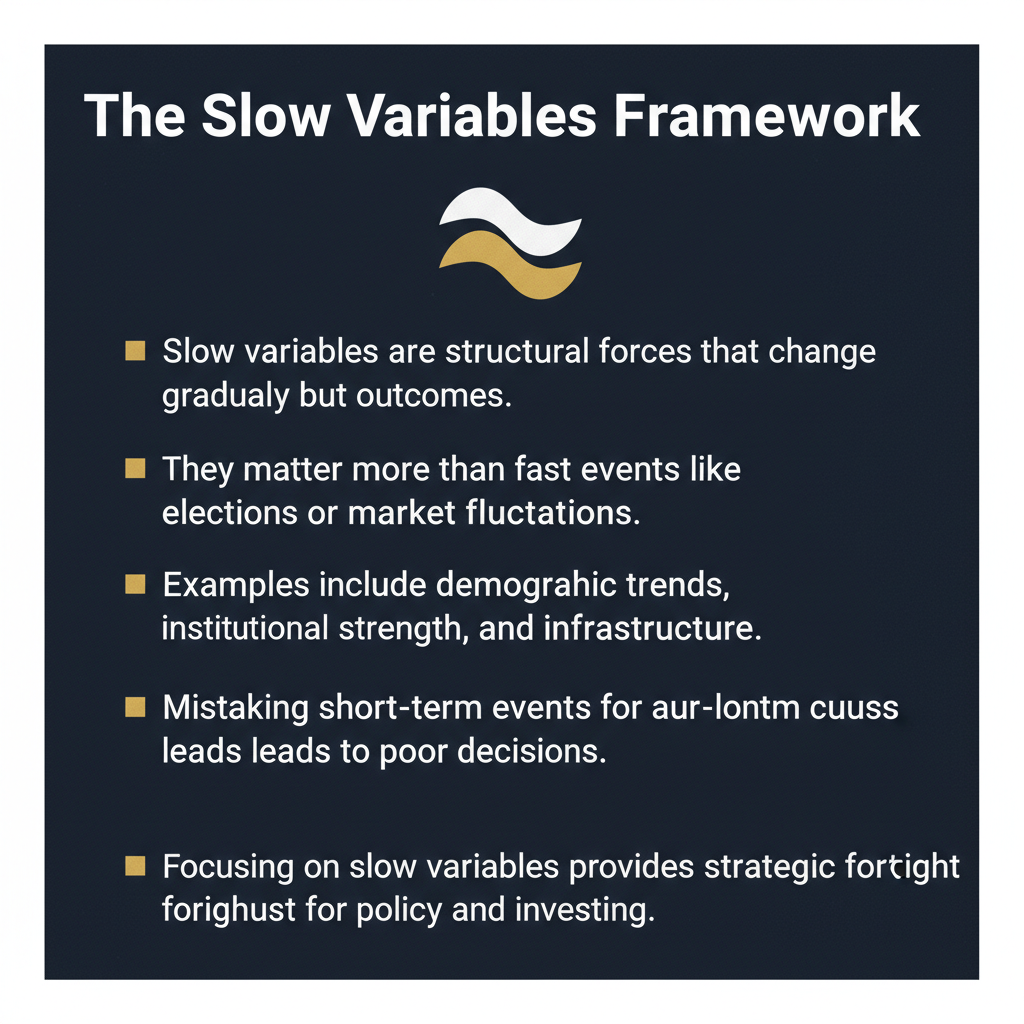
This analysis addresses why long-term trends shape outcomes more than daily events. The research suggests that slow-moving forces like population changes, institutional strength, and infrastructure determine what is possible over time. These factors matter because they influence economic stability, policy effectiveness, and societal resilience. Mistaking short-term noise for long-term direction can lead to poor decisions with lasting consequences.
What Are Slow Variables in Systems Thinking?
Slow variables are structural elements within complex systems that change gradually but exert disproportionate influence over time. Unlike fast variables—such as stock prices, political elections, or media cycles—slow variables operate beneath immediate visibility. Examples include demographic trends, institutional norms, physical infrastructure, and cultural values. In systems thinking, they function as 'stocks' that accumulate over decades, such as educational attainment levels or judicial precedents, and constrain or enable future actions. Their power lies not in visibility but in persistence: once established, they shape the range of possible outcomes for generations.
Why Slow Variables Matter More Than Events
Events are transient; slow variables are determinative. A market crash or election result may dominate headlines, but long-term labor shortages, aging populations, or energy grid limitations define the boundaries within which those events unfold. Research indicates that fast variables often reflect noise rather than signal in complex adaptive systems. The analysis suggests that decision-makers who focus on visible events risk misallocating attention and resources, while those who monitor slow variables gain foresight into structural shifts. This is not to dismiss events entirely, but to subordinate them to deeper forces that govern system behavior over time.
How to Identify Slow Variables
Identifying slow variables requires shifting attention from volatility to persistence. Ask: Does this factor change incrementally over decades rather than days? Does it shape the context in which decisions are made? Common categories include demographic composition, institutional durability, technological adoption curves, and built infrastructure. For instance, fertility rates set in the 1970s directly influence labor supply in the 2030s. Similarly, court appointments and regulatory frameworks outlast individual administrations. Tools from resilience thinking, such as the adaptive cycle model, help distinguish between fast fluctuations and enduring structures by mapping feedback loops and system memory.
Common Mistakes in Assessing Slow Variables
One common error is mistaking fast variables for causal drivers when they are often symptoms. For example, inflation spikes may prompt immediate policy responses, but underlying demographic aging or energy dependency may be root causes. Another mistake is ignoring time delays between cause and effect—infrastructure investments made today only manifest in economic capacity years later. Additionally, analysts often overlook feedback loops, such as how declining trust in institutions erodes policy effectiveness, further accelerating institutional decay. These oversights lead to reactive rather than strategic decision-making.
Applications in Decision-Making and Strategy
The Slow Variables Framework offers a strategic advantage in policymaking, investing, and organizational planning. In public policy, recognizing demographic aging can inform pension and healthcare reforms decades in advance. In investing, understanding technology diffusion curves allows positioning ahead of tipping points. Organizations can use the framework to align talent development with long-term skill demand rather than short-term labor trends. By focusing on structural forces, leaders reduce exposure to narrative-driven volatility and build resilience against shocks that disrupt fast-variable-dependent strategies.
Linking Slow Variables to Resilience Thinking
The framework aligns with Principle 3 of resilience thinking: 'Manage slow variables and feedbacks.' As articulated by the Stockholm Resilience Centre, systems collapse often occurs when slow variables—like soil degradation or social cohesion—are ignored until thresholds are crossed. Managing them requires monitoring indicators that track structural health, not just performance metrics. This approach enables early intervention before system shifts become irreversible. The analysis suggests that integrating slow variable assessment into governance improves adaptive capacity and reduces vulnerability to surprise.
Visual Summary
Beyond the Obvious
A less popular but compelling view holds that the real power of the slow variables framework lies not in systems science alone, but in its historical precedent: Fernand Braudel’s concept of the longue durée. In the 1950s, the French historian challenged event-based history by arguing that geography, climate, and social structures—forces that evolve over centuries—were the true engines of change. Revolutions and wars, he insisted, were surface disturbances atop deep-seated rhythms. This perspective was radical at the time, dismissed by contemporaries focused on political narratives. Yet today, Braudel’s insight resonates across disciplines: in ecology, where baseline conditions shape recovery after disturbances; in economics, where trust and norms underpin market function; and in geopolitics, where civilizational patterns persist despite regime changes. The convergence between Braudel’s historical method and modern resilience science is not coincidental—it reflects a deeper truth about causality in complex systems. Where most analysis stops at the event, the enduring value of slow variables is their ability to connect today’s decisions to multi-decadal trajectories, offering a rare form of intellectual leverage in an age of distraction.