What Is the Silver Economy? Defining the Senior Market Impact
In Plain English
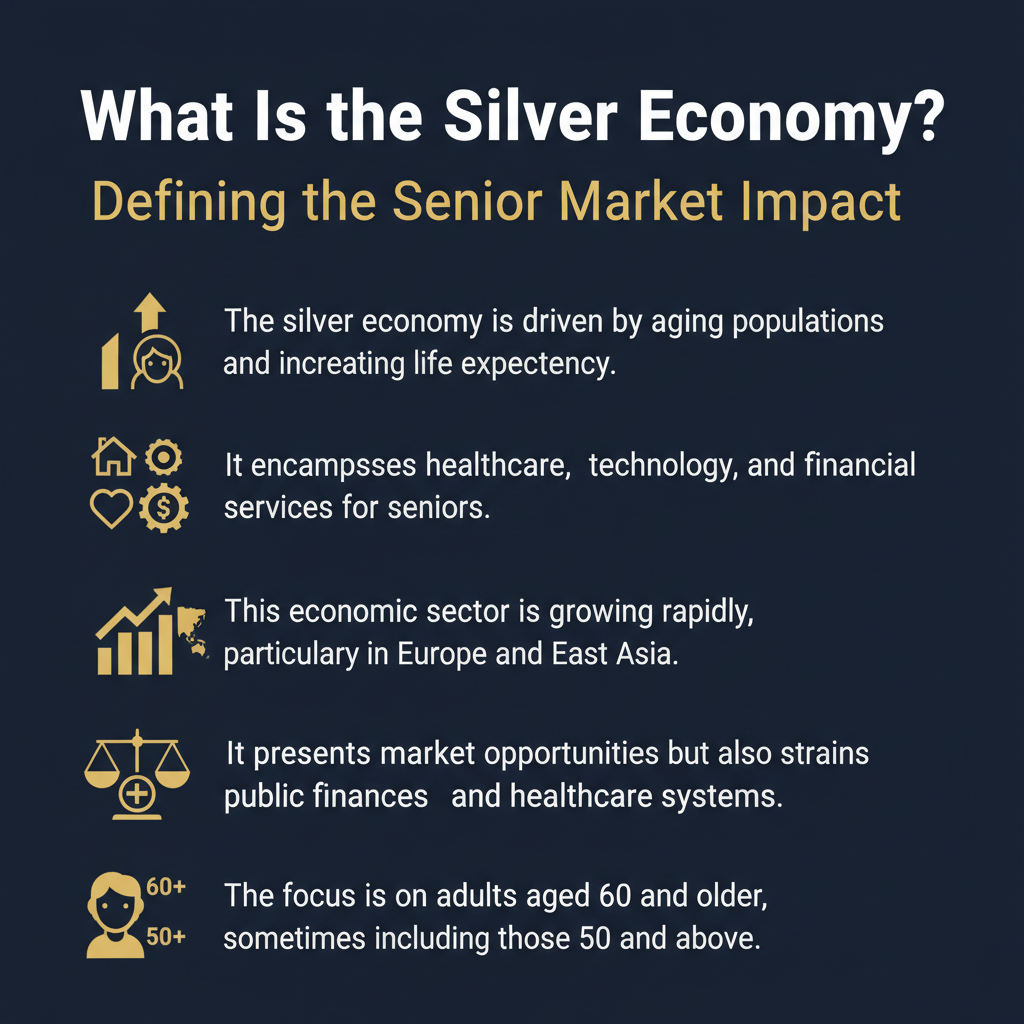
The term 'silver economy' refers to the economic activity surrounding older adults, not the price of silver metal. Research suggests this sector is growing due to longer lifespans and aging populations in many countries. The analysis indicates that healthcare, technology, and financial services are adapting to meet senior needs. This matters because it affects public spending, job markets, and the design of cities and products worldwide.
Defining the Silver Economy
The silver economy refers to the economic ecosystem that emerges from the needs, consumption patterns, and labor participation of older adults, typically aged 60 and above. It encompasses healthcare, housing, financial services, leisure, and technology tailored to aging populations. According to the IMF and European Union, this sector is expanding rapidly due to demographic shifts, particularly in high-income and aging societies. The term should not be confused with the silver commodity market, despite phonetic similarity.
What Is the Age Range for the Silver Economy?
While no universal standard exists, most frameworks define the silver economy as serving individuals aged 60 and older. However, the European Commission and OECD often use 50+ to capture 'pre-retirement' economic behavior, including long-term financial planning and health investments. In rapidly aging countries like Japan and Germany, the active contribution of those 65–74 is increasingly central to labor and consumer markets. This variability reflects differing retirement norms, life expectancy, and social policies across regions.
Silver Economy vs. Silver Commodity Market: Clarifying the Confusion
A common misunderstanding conflates the silver economy with the price and trading of physical silver. The PAA questions about silver prices and economic collapse pertain to commodity speculation, not the demographic-driven silver economy. While some reports, such as those from investment firms, may use 'silver economy' metaphorically in asset discussions, the term in policy and academic contexts refers exclusively to economic activity around aging populations. This article focuses on the latter, structural interpretation.
Economic and Social Impact of Aging Populations
The silver economy is reshaping national growth models, particularly in Europe and East Asia. As life expectancy rises and fertility declines, the proportion of older adults increases, altering consumption, labor supply, and public spending. Healthcare and elder care absorb larger shares of GDP, while demand for age-friendly infrastructure and financial products grows. The IMF notes that without adaptive policies, these shifts can strain public finances, but with innovation, they present market opportunities and social resilience.
Technology and Innovation in the Silver Economy
Digital tools are transforming how services are delivered to older populations. AI-driven financial advisory platforms, remote health monitoring, smart home systems, and mobility aids are increasingly integrated into daily life. Research indicates that digital-silver economy coupling enhances independence and reduces care costs. Countries like South Korea and Sweden are piloting national programs linking digital infrastructure with elder services, suggesting a broader trend toward tech-enabled aging support systems.
Policy Frameworks and the European Approach
The European Union has formalized the silver economy as a strategic priority, promoting inclusive growth through the European Innovation Partnership on Active and Healthy Ageing. Policies emphasize lifelong learning, age-friendly cities, and cross-border service standards. The EU also supports entrepreneurial ventures targeting seniors, recognizing the sector’s potential for job creation. These efforts reflect a proactive, systemic response to demographic change rather than a reactive fiscal adjustment.
Visual Summary
Beyond the Obvious
A less widely recognized but critical dimension of the silver economy lies in Japan’s 'Society 5.0' initiative, which integrates robotics, AI, and human-centered design into elder care at a national scale. Unlike Western models that often treat aging as a social or fiscal challenge, Japan frames it as a catalyst for systemic innovation. The government subsidizes robotic exoskeletons for caregivers, deploys AI companions in rural nursing homes, and uses sensor networks to monitor seniors living alone—turning demographic decline into a testbed for scalable automation. This approach diverges from the EU’s regulatory focus or U.S. market-driven solutions, proposing that the silver economy is not just about serving older people but re-engineering society around intergenerational resilience. Historical context is key: Japan’s rapid aging began earlier than elsewhere, forcing policy experimentation that now informs global strategies. This synthesis of technology, demography, and national identity offers a non-Western model that challenges the assumption that aging economies are inherently stagnant.