AI Accountability: Who Is Responsible When Machines Make Decisions?
In Plain English
This analysis addresses who should be held responsible when artificial intelligence systems make decisions that lead to harm. Research suggests that accountability typically falls on the people and organizations that design, deploy, or oversee the technology—not the machine itself. Historical and legal precedents indicate that responsibility is shared rather than singular. This matters because clear accountability rules are necessary to ensure public trust, safety, and fairness as AI becomes more embedded in critical areas like health and transportation.
What Does AI Accountability Mean?
AI accountability refers to the mechanisms by which decisions made by artificial intelligence systems can be traced, explained, and assigned to responsible parties. It is not about punishing machines but ensuring that humans and institutions remain answerable for outcomes. Research suggests accountability involves transparency in design, oversight during deployment, and auditability after use. Without these safeguards, public trust in automated systems erodes, particularly in high-stakes domains like healthcare and criminal justice.
Who Is Accountable for AI Decisions?
Responsibility typically falls on multiple actors: developers who design the system, organizations that deploy it, and regulators who oversee its use. The analysis suggests that no single entity bears full liability—instead, accountability is distributed. For example, a hospital using an AI diagnostic tool shares responsibility with the vendor that built it. Legal frameworks increasingly emphasize shared liability, particularly when systems operate with limited human oversight. This distributed model reflects lessons from product liability and corporate governance.
Who Is Responsible If an AI System Makes a Mistake?
When AI errors occur, liability often depends on context and jurisdiction. In cases involving autonomous vehicles or medical diagnostics, courts may apply product liability principles, holding manufacturers accountable for defects. However, if a user overrides warnings or misconfigures the system, responsibility may shift. The research indicates that current law struggles to address hybrid decision-making, where human and machine inputs are intertwined. This has led to calls for new legal categories that reflect the collaborative nature of modern AI use.
Can AI Be Held Legally Accountable?
No legal system currently grants AI personhood or independent liability. The analysis suggests this is unlikely to change, as accountability requires intent and moral agency—qualities AI lacks. Instead, legal responsibility is assigned to human or corporate entities. Some scholars propose a 'robot identification' framework using cryptographic hashes to track AI decisions, similar to black-box recorders in aviation. While such tools enhance traceability, they do not confer legal personhood on the AI itself.
Accountability in AI Healthcare Decisions
In healthcare, AI accountability is especially critical due to patient safety risks. If an AI recommends an incorrect treatment, responsibility may lie with the hospital, physician, or software developer, depending on how the tool was used. Research indicates that existing surgical safety standards could be adapted for AI-assisted procedures. Regulatory bodies like the FDA are exploring pre-market validation and post-deployment monitoring to ensure ongoing accountability in clinical settings.
Responsible AI and the 10 20 70 Rule
The '10 20 70 rule' is sometimes cited in AI training data discussions, though it is not a formal standard. It suggests that 10% of outcomes may be explained by model design, 20% by data quality, and 70% by deployment context—including human decisions. This framework highlights that accountability must extend beyond the algorithm to include organizational practices. The analysis suggests that most AI failures arise not from flawed code but from misalignment between system design and real-world use.
AI Governance and Accountability Frameworks
Governments and institutions are developing accountability frameworks to guide AI deployment. The European Union’s Artificial Intelligence Act, for example, classifies systems by risk and assigns oversight duties accordingly. These frameworks emphasize documentation, impact assessments, and human-in-the-loop requirements. The research suggests that effective governance requires both technical standards and institutional accountability—mirroring earlier regulatory approaches to pharmaceuticals and financial algorithms.
Visual Summary
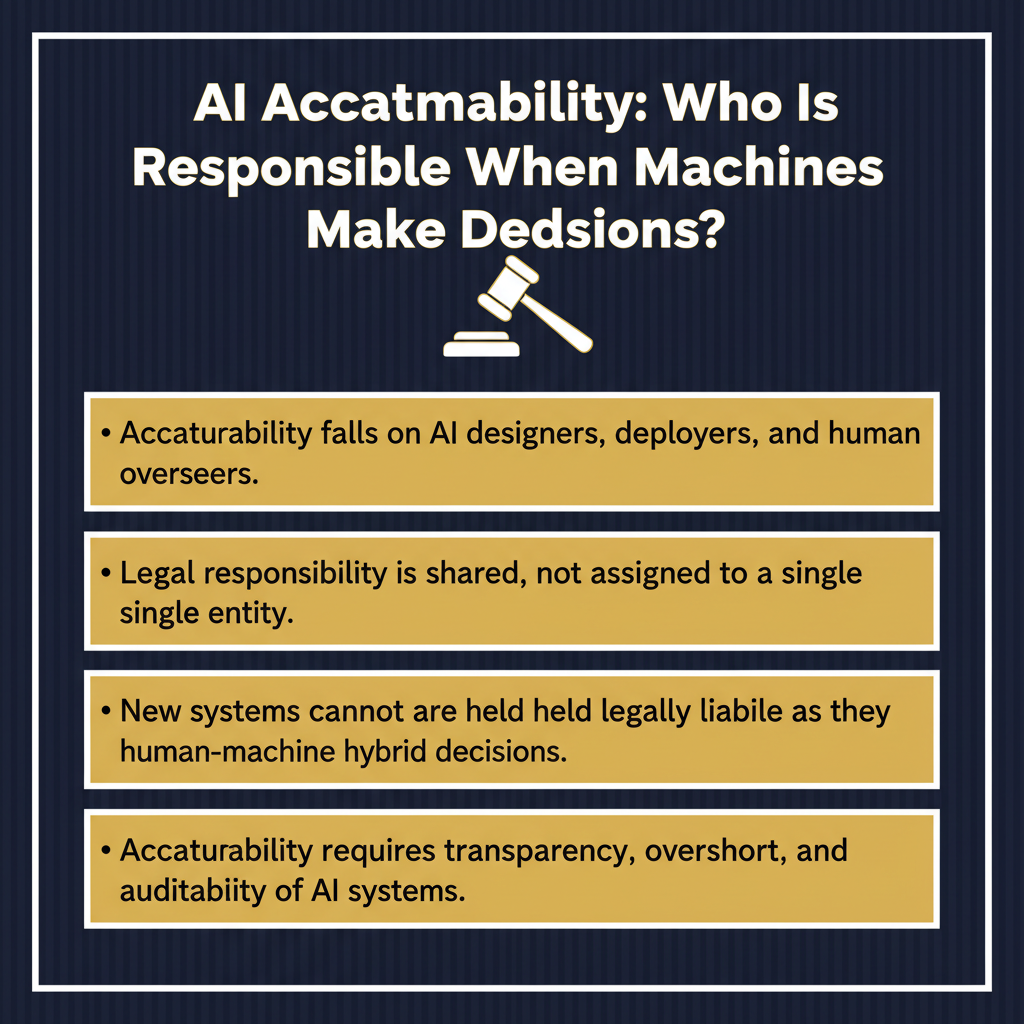
Beyond the Obvious
The legal struggle to assign accountability for AI decisions closely mirrors the 19th-century debate over corporate personhood—a precedent rarely drawn in contemporary AI discourse. In the 1819 Dartmouth College case and the 1886 Santa Clara County decision, U.S. courts grappled with whether a corporation, as a non-human entity, could hold rights and responsibilities. The resolution was not to treat the corporation as a person, but to create a legal fiction that allowed liability to be traced through directors and shareholders. This same logic is now being applied to AI: rather than granting machines personhood, regulators are constructing layered liability frameworks where developers, operators, and overseers are held accountable in proportion to their control. A less popular but compelling view, proposed in recent European legal scholarship, argues that AI systems should be treated as 'electronic agents' under maritime law—analogous to ships acting under a captain’s command. Under this model, the operator is always liable, regardless of autonomy level, just as shipowners remain responsible for their vessels even in storm conditions. This historical continuity suggests that AI accountability is less a technological challenge than a reactivation of old legal principles in new forms.